
Gutter Cleaning, Repair, or Replacement? A Rainwater-Control Guide
A U.S. homeowner inspection and quote-comparison framework for gutters, downspouts, fascia, drainage, and recurring overflow.

Key takeaways
- Treat gutters and downspouts as one water path from roof edge to safe discharge.
- Debris calls for cleaning; leakage, loose fasteners, poor slope, or isolated damage may be repairable; chronic capacity or system failure may justify replacement.
- Overflow does not prove the gutter is too small until blockages, slope, outlets, downspouts, roof geometry, and discharge are checked.
- Direct water away from the foundation without creating erosion, ice, or neighbor impacts.
- Use ground observations and qualified help rather than unsafe ladder work.
A gutter problem is rarely just a gutter-channel problem. Rain must leave the roof, enter the channel, reach an outlet, pass through a downspout, and discharge where the site can manage it. Cleaning only the channel may not help a blocked underground drain. Replacing gutters may not help if roof valleys overshoot the edge or the ground sends water back toward the foundation. Diagnose the complete path before choosing a service.
Use safe ground observations and hire qualified help when roof-edge access is required. Wet roofs, power lines, damaged fascia, steep grades, and unstable ladders create serious hazards.
Select the least extensive effective response
| Response | Evidence that supports it | What to verify afterward |
|---|---|---|
| Clean | Leaves, granules, nests, sediment, or blocked strainers restrict an otherwise sound system | Free flow through outlets and downspouts; no concealed blockage |
| Repair or realign | Localized seam leaks, loose hangers, damaged sections, poor pitch, failed outlets, or isolated fascia damage | Correct slope, secure attachment, sealed joints, sound substrate, and controlled discharge |
| Replace or add capacity | Widespread corrosion, repeated separation, undersized channels or outlets, incompatible roof changes, or chronic overflow after maintenance | Sizing rationale, outlet count, downspout route, attachment, expansion, and site drainage |
Observe the system during or just after rain
Map each failure point
- Water running behind the gutter or missing the channel at valleys
- Overflow at a specific low point, end, corner, or outlet
- Standing water after rain, sagging, pulled fasteners, open seams, rust, holes, or cracked components
- Downspouts leaking at joints, disconnected, crushed, blocked, or too few for the roof area
- Staining, rot, peeling paint, or movement at fascia and soffits
- Ponding, erosion, splashback, basement dampness, crawl-space moisture, or ice near discharge points
InterNACHI's inspection guidance emphasizes condition, adequate sizing, and directing runoff away from the foundation. Distance alone is not a universal solution: the discharge must work with grading, soil, walkways, neighboring property, frost conditions, and local stormwater rules. Underground connections should be identified and tested rather than assumed open.
Ask why overflow occurs
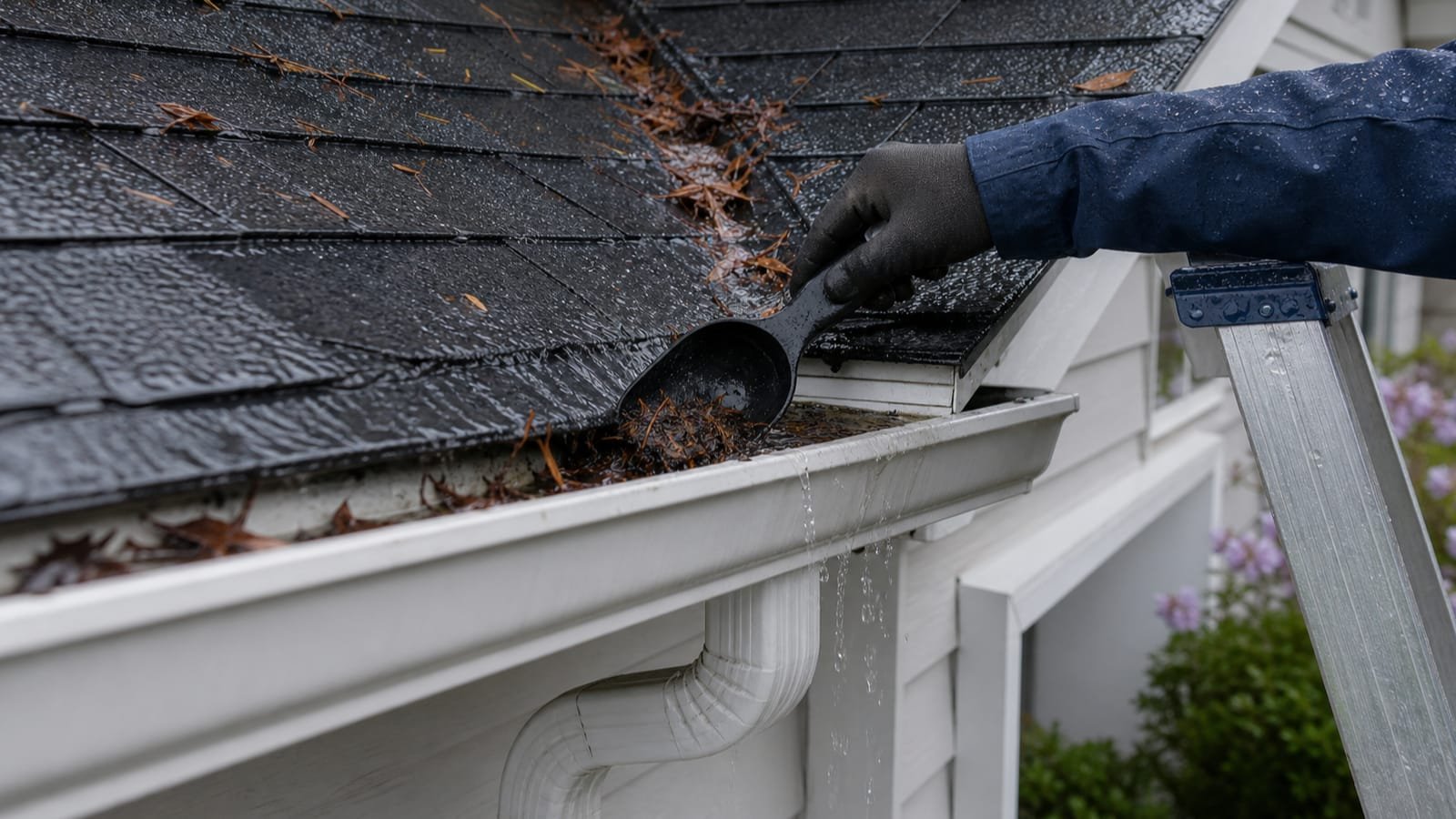
Overflow diagnosis
| Observed pattern | Questions to investigate |
|---|---|
| Only during intense rain | Roof area, pitch, valleys, channel and outlet capacity, downspout count, and splash guards |
| At one outlet | Debris, outlet size, elbow restriction, downspout blockage, underground drain, and pitch |
| Behind the gutter | Drip edge, flashing, roof projection, gutter position, fascia condition, and attachment |
| After every rain | Standing water, reverse pitch, sagging, settlement, or trapped debris |
| Foundation remains wet | Downspout discharge, grading, hardscape, subsurface drainage, plumbing, and other water sources |
In wildfire-prone areas, roof and gutter debris can also become an ignition concern. FEMA guidance discusses noncombustible gutter materials, drip-edge relationships, and reducing debris accumulation. Homeowners should follow current local fire guidance because exposure and requirements vary.
Compare gutter proposals by system, not linear feet
Proposal fields to normalize
- Measured roof drainage areas, high-flow valleys, and the sizing basis
- Channel profile, material, thickness or specification, finish, expansion approach, and joint layout
- Hanger type and spacing, fastening substrate, fascia repairs, and drip-edge or flashing interfaces
- Outlet size and location, downspout dimensions, elbows, cleanouts, extensions, and underground connections
- Removal, disposal, landscape protection, testing, cleanup, schedule, and warranty
- What is excluded: roofing, fascia, soffit, painting, underground drainage, grading, or water-damage repair
Separate gutter work from site-drainage work
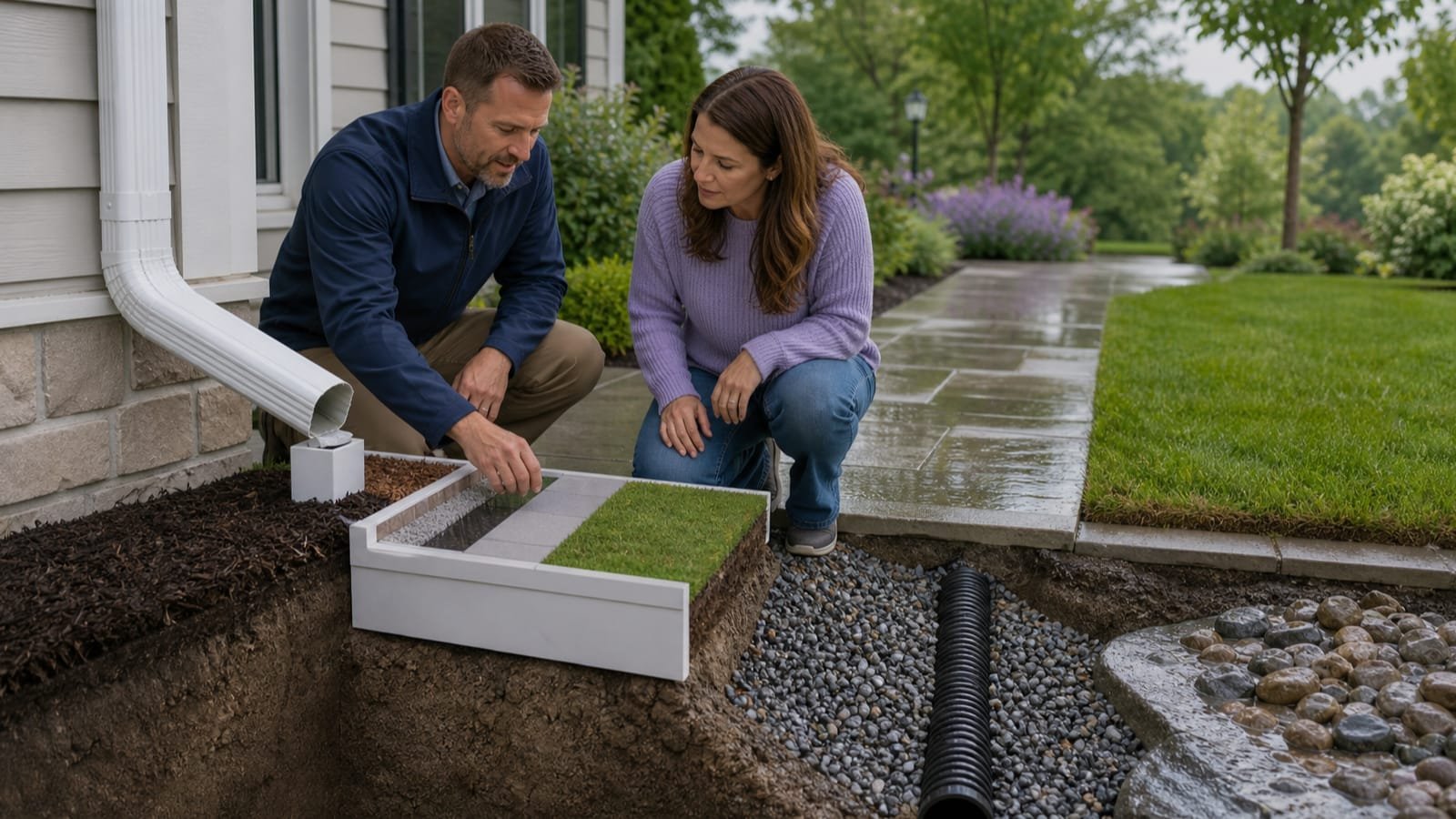
A downspout extension can move roof water away from the wall, but its endpoint still needs a safe path. Ask whether water will pond, erode soil, cross a walkway, freeze, undermine landscaping, overload an underground line, or flow toward a neighboring property. If a proposal connects to subsurface drainage, identify the pipe route, condition, capacity, outlet, access for cleaning, and who verifies it is open.
Where responsibility changes
| Boundary | Gutter contractor may address | Separate expertise may be needed |
|---|---|---|
| Roof edge | Channel position, hangers, outlets, splash control, and limited interfaces | Roof covering, complex flashing, rotten decking, or roof redesign |
| Fascia and soffit | Defined repair or replacement if included | Widespread decay, insects, structure, or concealed water source |
| Grade-level discharge | Extensions, elbows, splash blocks, or defined connections | Grading, hardscape, foundation drainage, storm sewer, dry well, erosion, or property-line issues |
| Interior moisture | Evidence that runoff management is functioning | Basement, crawl-space, plumbing, groundwater, mold, or structural diagnosis |
Create a maintenance plan for the actual debris load
Maintenance variables
- Tree species, needles, seed pods, roof moss, animal activity, roof granules, and nearby construction dust
- Roof valleys, upper roofs discharging to lower roofs, long channel runs, inside corners, and limited outlets
- Seasonal storms, snow and ice, wildfire exposure, and safe access
- Whether guards can be opened, removed, cleaned, and reinstalled without damaging roofing or warranties
- How underground drains, strainers, elbows, and outlets are inspected and cleared
- Who documents maintenance when a workmanship or material warranty requires it
Set inspection frequency from conditions rather than a generic calendar. A low-debris open site may need less attention than a wooded property with valleys and hidden underground connections. Reinspect after severe weather, nearby roof work, tree work, or any new staining or erosion. If safe observation is difficult, include accessible cleanouts or professional inspection in the design.
Verify performance before final payment
Check alignment, secure attachment, joints, end caps, outlets, downspout connections, discharge, fascia repairs, finish damage, cleanup, and the agreed testing method. Water testing can reveal local leaks or drainage faults, but it may not reproduce wind-driven rain or peak roof flow. Photograph concealed repairs and retain the measured layout, material specification, color, warranty, maintenance instructions, and discharge map.
Read exclusions for debris, ice, wind, trees, roof defects, fascia, settlement, underground drains, maintenance, overflow, and consequential water damage. Ask what the installer will inspect and remedy if the same symptom returns.
Do overflowing gutters always need replacement?
No. Debris, blocked outlets, poor pitch, loose hangers, or downspout restrictions may be correctable. Replacement becomes more defensible when deterioration or capacity problems are widespread.
Will gutter guards eliminate cleaning?
No universal product eliminates inspection and maintenance. Performance depends on debris type, roof geometry, rainfall, product design, installation, and access for service.
Can gutters fix a wet basement?
They can reduce roof-water loading when runoff is part of the cause, but below-grade moisture can also involve grading, groundwater, cracks, plumbing, vapor, or condensation. Diagnose those separately.
Related offers


Sources
Facts and figures in this guide that come from an outside authority are backed by the sources below. Pricing, program rules, and eligibility details change — always confirm current specifics with the source directly or a licensed professional before acting.
- Gutters and Downspouts Technical Fact SheetFederal Emergency Management Agency · Accessed 2026-07-19
- Addressing Indoor Environmental Concerns During RemodelingU.S. Environmental Protection Agency · Accessed 2026-07-19
- Inspecting Gutters and DownspoutsInternational Association of Certified Home Inspectors · Accessed 2026-07-19
- Moisture in Basements: Causes and SolutionsUniversity of Minnesota Extension · Accessed 2026-07-19
- Contractor Selection ChecklistNational Association of the Remodeling Industry · Accessed 2026-07-19
Editorial information
- We prioritize primary, authoritative sources over provider marketing.
- Commercial relationships never influence what we publish or how it's written.
- Pages are dated and updated only when they've genuinely been reviewed or changed.
Related guides
Basement Waterproofing or Crawl-Space Encapsulation? Diagnose Moisture First
Identify bulk water, capillary moisture, vapor, condensation, plumbing leaks, and radon before choosing basement waterproofing or crawl-space encapsulation.

DIY or Professionally Monitored Home Security? A Privacy and Contract Guide
Compare self-monitored and professional home-security systems using response, resilience, privacy, ownership, contract, and local-permit questions.
HVAC Repair or Replacement? A Homeowner Decision Guide
Use a diagnosis-first framework to compare HVAC repair and replacement, evaluate competing quotes, and avoid paying for the wrong solution.
Ready to explore Gutter Cleaning & Repair?
Continue your research or check availability — there's no cost and no obligation.