
How to Compare Residential Solar Quotes Without Relying on Savings Claims
A U.S. homeowner worksheet for comparing cash, loan, lease, and power-purchase proposals without treating projections as guarantees.

Key takeaways
- Compare the same system boundary, not just price or payment.
- Separate DC array size, inverter capacity, modeled production, utility assumptions, and household consumption.
- Savings and payback are scenarios, not guarantees.
- Ownership, financing, roof work, warranties, monitoring, removal, transfer, and end-of-term obligations can change the value materially.
- Verify installer credentials, licensing, contract terms, and current utility rules independently.
Solar proposals can look precise because they contain charts, percentages, and long-term projections. Precision is not certainty. Production depends on design, shade, weather, equipment, degradation, outages, and maintenance. Bill outcomes also depend on consumption, utility rates, export rules, fixed charges, and contract structure. A sound comparison separates what is physically installed, what is contractually promised, and what is merely modeled.
The FTC warns that misleading solar promotions may use government affiliation, free-system claims, inflated savings, or pressure tactics. Verify the company and financing independently. This guide does not present solar as free and does not rely on grants or government-program marketing.
Normalize the system design
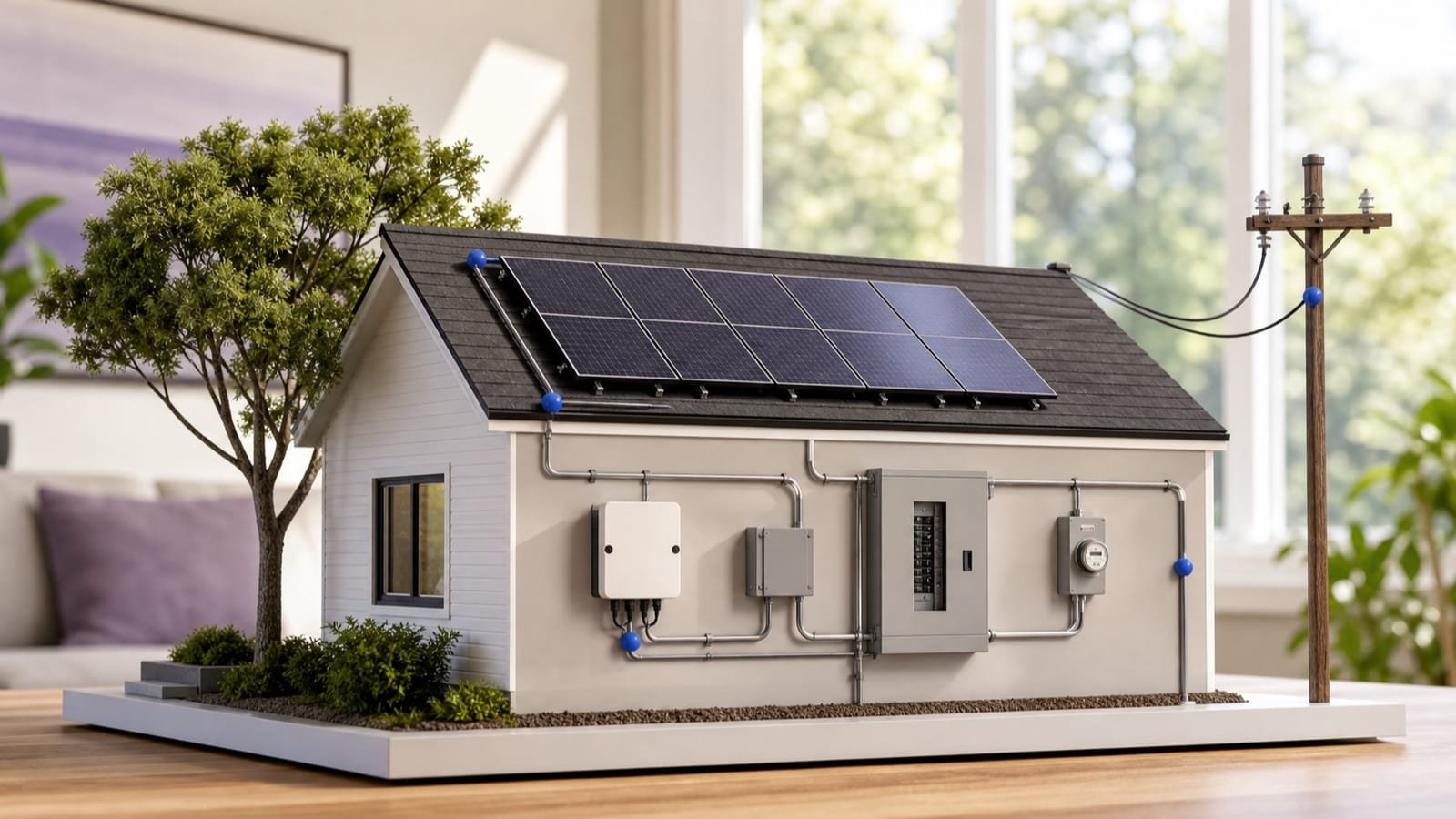
Physical-system comparison
| Field | Record from every proposal |
|---|---|
| Array | Module manufacturer and model, count, DC size, location, tilt, azimuth, and shade assumptions |
| Conversion | Inverter or microinverter models, AC capacity, clipping assumptions, rapid-shutdown equipment, and monitoring |
| Production | First-year kWh estimate, modeling tool, weather dataset, losses, degradation, and whether storage changes the model |
| Roof and structure | Roof age and condition, attachment method, flashing, structural review, reroof coordination, removal and reinstallation responsibility |
| Electrical | Panel and service work, utility interconnection, meter changes, critical-load equipment, and permit responsibility |
| Closeout | Commissioning results, as-built documents, permits, utility approval, manuals, account access, and emergency shutdown labeling |
Use NREL's PVWatts Calculator as an independent reasonableness check, not a promise. Enter comparable system and site assumptions, then ask each installer to explain material differences. A proposal with higher modeled output may simply assume less shade, lower losses, a different weather year, or more favorable orientation.
Rebuild the economics from transparent assumptions
Inputs behind a savings projection
- Current annual electricity use and expected changes such as an EV, heat pump, addition, or occupancy shift
- Current utility tariff, fixed charges, time-of-use periods, export credit, and interconnection rules
- Expected self-consumption, exported energy, storage behavior, and backup limitations
- Utility-rate escalation, production degradation, maintenance, insurance, equipment replacement, and downtime assumptions
- Cash price separated from dealer fees, loan interest, payment changes, lease payments, escalators, and buyout terms
- Current incentive eligibility verified from official sources at the time of contract—not assumed from old marketing material
Ask for a version of the analysis with no utility-rate escalation and a conservative production case. If the proposal only works under aggressive assumptions, that is useful information. Do not compare a cash price from one company with a financed total or lease payment from another. Record the total obligation, ownership, tax treatment, lien or security interest, transfer conditions, and early-payoff or prepayment terms.
Contract structures change the homeowner's role
| Structure | Homeowner should verify | Common comparison trap |
|---|---|---|
| Cash purchase | Scope, ownership, warranties, maintenance, and total installed price | Comparing before-tax or partial scope with another proposal's complete price |
| Loan | Cash-equivalent price, fees, rate, term, payment changes, total payments, security interest, and prepayment | Choosing the lowest payment without comparing total obligation |
| Lease | Payment schedule, escalator, performance obligations, maintenance, transfer, buyout, removal, and end of term | Treating a lease as ownership |
| Power purchase agreement | Energy price, escalator, minimums, production treatment, transfer, buyout, access, and end of term | Comparing the starting rate without modeling the contract duration |
Make warranties operational
Warranty and service questions
- Who is responsible for workmanship, modules, inverters, optimizers, racking, roof penetrations, monitoring, and labor
- Whether the installer or manufacturer must remain in business for a remedy
- Who diagnoses failures and who pays truck rolls, shipping, removal, access, and reinstallation
- Response targets, production guarantees if any, exclusions, claim procedure, and transferability
- What happens when roofing, electrical, or utility work requires temporary removal
- How monitoring data can be exported if the service platform or ownership changes
Credentials are one input, not a substitute for due diligence. NABCEP maintains consumer resources and a directory of credentialed professionals. Also verify state or local licensing, insurance, references for comparable installations, subcontractor roles, complaint history, permit records where available, and the exact legal entity named in the contract.
Evaluate storage as a separate decision

A battery changes the design, operating assumptions, controls, critical-load planning, equipment location, permitting, warranty, and economics. Ask what objective it serves: outage backup, time-of-use shifting, demand management, solar self-consumption, or another use. Record usable capacity, continuous and surge power, supported loads, expected runtime assumptions, reserve settings, chemistry, location, temperature limits, degradation, replacement, monitoring, fire and electrical requirements, and whether the system can charge or operate during a grid outage.
Backup claim reality check
| Claim | Information needed |
|---|---|
| Runs the home | Exact backed-up circuits, simultaneous load limits, motor-starting capability, and automatic shedding |
| Lasts through an outage | Starting charge, load profile, weather, solar availability, reserve, efficiency, and battery condition |
| Black-start capable | How the system restarts when both grid and battery reach their limits |
| Expandable later | Compatible equipment, physical space, permits, software, warranty, and future product availability |
| Reduces bills | Tariff, control mode, cycling assumptions, degradation, and whether backup reserve limits savings |
Use a weighted quote score instead of one headline number
Score every proposal from evidence
- Site and roof fit: shade, condition, structural assumptions, layout, setbacks, attachments, and reroof plan
- Electrical and utility fit: service, interconnection, meter, export rules, permits, and operating modes
- Model transparency: inputs, losses, first-year production, degradation, tariff, consumption, and sensitivity cases
- Contract clarity: ownership, cash-equivalent price, fees, total obligation, transfer, cancellation, access, removal, and end of term
- Serviceability: installer qualifications, equipment support, monitoring, diagnosis, labor, warranty claims, and business continuity
- Closeout: commissioning, inspections, utility authorization, as-builts, labels, manuals, account ownership, and emergency procedure
Set the weights before reading the sales rankings. A household planning to move may weight transfer terms heavily. A home with an aging roof may weight removal responsibility and roof coordination. A household seeking outage resilience should weight supported loads and service response rather than projected bill reduction. A single universal score would conceal those priorities.
Do not sign until these blanks are closed
- The legal seller, installer, electrician, financier, system owner, monitoring provider, and warranty contacts are identified
- The site plan, exact models, system sizes, roof and electrical work, exclusions, and substitution rules are attached
- Utility approval is not represented as guaranteed, and responsibility for redesign or cancellation is written
- All verbal production, roof, savings, tax, buyout, transfer, and service statements appear in the contract or are disregarded
- Cancellation, payment, lien, financing, delivery, delay, damage, change, dispute, removal, moving, and end-of-term provisions have been reviewed
- The homeowner has copies of every signed document and enough time to seek independent legal, tax, financial, roofing, or engineering advice
A homeowner may reasonably defer solar when the roof, utility terms, financing, contract, shade, service model, or household plans do not support a clear decision. The purpose of comparison is informed choice, not installation at any cost.
Should the largest solar system win?
No. Size should follow usable roof area, electrical constraints, household load, utility rules, budget, and the homeowner's objectives. Oversizing can create export or interconnection issues without proportional value.
Is a production estimate a guarantee?
Not unless the contract explicitly creates an enforceable guarantee with defined measurement, exclusions, remedy, and duration. Most models are projections based on assumptions.
Should I replace an aging roof first?
Coordinate the roof condition and expected service life with the array plan. Compare the cost, warranty, and responsibility for future removal and reinstallation before deciding.

Sources
Facts and figures in this guide that come from an outside authority are backed by the sources below. Pricing, program rules, and eligibility details change — always confirm current specifics with the source directly or a licensed professional before acting.
- Homeowner's Guide to Going SolarU.S. Department of Energy · Accessed 2026-07-19
- As Solar Energy's Popularity Rises, So Do ScamsFederal Trade Commission · Accessed 2026-07-19
- PVWatts CalculatorNational Renewable Energy Laboratory · Accessed 2026-07-19
- Residential Consumer Guide to Solar PowerSolar Energy Industries Association · Accessed 2026-07-19
- PV Consumer GuideNorth American Board of Certified Energy Practitioners · Accessed 2026-07-19
Editorial information
- We prioritize primary, authoritative sources over provider marketing.
- Commercial relationships never influence what we publish or how it's written.
- Pages are dated and updated only when they've genuinely been reviewed or changed.
Related guides

Gutter Cleaning, Repair, or Replacement? A Rainwater-Control Guide
Trace roof runoff from edge to discharge, then decide whether cleaning, repair, realignment, added capacity, or replacement fits the evidence.
Basement Waterproofing or Crawl-Space Encapsulation? Diagnose Moisture First
Identify bulk water, capillary moisture, vapor, condensation, plumbing leaks, and radon before choosing basement waterproofing or crawl-space encapsulation.

DIY or Professionally Monitored Home Security? A Privacy and Contract Guide
Compare self-monitored and professional home-security systems using response, resilience, privacy, ownership, contract, and local-permit questions.
Ready to explore Solar Installation?
Continue your research or check availability — there's no cost and no obligation.